Christmas in Sweden has a rhythm that feels different from the holiday season in many other countries. The lights come out early, Advent quietly sets the mood, and then Christmas Eve arrives as the true centerpiece. If you are curious about Christmas in Sweden traditions, the biggest surprise is how much of the celebration is built around family, food, candles, and calm rather than sheer spectacle. Some customs are centuries old, others are newer and delightfully quirky, and together they create one of Europe’s most distinctive holiday seasons.
If you are planning a winter trip, the Scandinavia Holiday homepage is a good place to start for Nordic travel ideas and local experiences.
What makes Christmas in Sweden traditions so distinctive?
Swedish Christmas, or jul, is shaped by long winter nights and a strong sense of home. The season is less about rushing from one event to another and more about building a gradual atmosphere. Candles appear in windows, saffron buns show up in bakeries, and families begin counting down with Advent wreaths and small weekly celebrations.
What stands out most is the timing. In Sweden, Christmas Eve is the main event, not Christmas Day. That one fact changes the whole holiday. Gifts are opened on the 24th, families gather that evening for dinner, and many of the best-loved traditions are built around that date.
Another important feature is the mix of sacred and secular traditions. Some households attend church services and sing carols, while others focus more on food, television, and being together. Most families blend the two in a way that feels natural to them.
The Swedish Christmas timeline at a glance
A Swedish Christmas is not a single day, it is a season that unfolds in stages. Here is a simple timeline that helps make sense of it.
| Date | Tradition | What happens |
|---|---|---|
| First Advent | Start of the season | Candles, baking, and the first holiday decorations appear |
| December 13 | Lucia Day | Candlelit processions, songs, and saffron buns |
| December 24 | Christmas Eve | The main celebration, with dinner, gifts, and family time |
| December 25 | Christmas Day | A quieter day for rest, church, or visiting relatives |
| December 26 | Boxing Day | More family visits, winter outings, or a slower pace |
| January 13 | St. Knut’s Day | The official end of the Christmas season for many households |
That long runway is one reason Christmas in Sweden feels so rich. The season builds slowly, peaks on Christmas Eve, and then winds down gradually instead of ending all at once.
Lucia Day brings light into the dark season

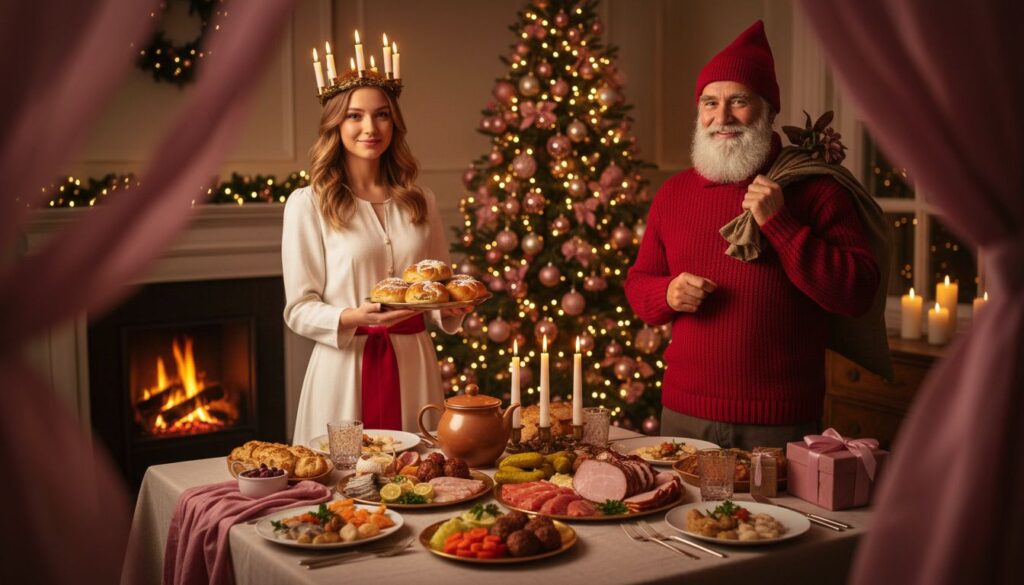
Lucia Day on December 13 is one of the most beloved Christmas in Sweden traditions. It comes right in the middle of the darkest part of the year, which gives it a special emotional weight. The tradition centers on light, music, and a young woman dressed in white with a crown of candles on her head. She is often joined by a procession of children and singers carrying candles and wearing white robes.
The songs are gentle and old-fashioned, and the atmosphere is usually calm rather than loud. In schools, workplaces, churches, and local community centers, Lucia processions mark the beginning of the final stretch toward Christmas. Many Swedes remember Lucia Day from childhood, so it carries a strong feeling of nostalgia.
You will also find saffron buns called lussekatter, which are shaped in a distinctive curl and flavored with saffron. They are closely tied to the celebration and are often served with coffee or hot chocolate.
Lucia is not just a pretty tradition. It expresses something deeply Swedish, a way of meeting winter with light, music, and togetherness.
Christmas Eve is the real main event
In many countries, the biggest moment arrives on Christmas Day. In Sweden, it happens the evening before. Christmas Eve, or julafton, is the point where everything comes together.
For many families, the day has a comforting routine. The afternoon may start with a visit to the church, a walk, or a few quiet hours at home. Later comes the holiday meal, followed by gift-giving and time with relatives. The pace is usually unhurried, and the goal is not to fill every minute. The goal is to be together.
One of the most famous Swedish Christmas customs is the 3 p.m. television broadcast of Donald Duck, known in Sweden as Kalle Anka och hans vänner önskar God Jul. For decades, families have gathered to watch the same animated clips every year. It sounds unusual to visitors, but for many Swedes it is as familiar as carols or a Christmas tree.
If you are trying to understand Christmas in Sweden traditions, this is a good rule of thumb: Christmas Eve is when gifts are exchanged, dinner is served, and the holiday truly begins.
What ends up on a Swedish Christmas table?
The holiday table is where Swedish Christmas becomes especially memorable. The traditional meal is called a julbord, which is a buffet rather than a single plated dinner. That matters, because a julbord is meant to be sampled in stages.
A classic julbord often includes:
- Pickled herring in several flavors
- Gravad lax, or cured salmon
- Meatballs
- Small sausages, often prinskorv
- Christmas ham, usually served sliced and sometimes glazed
- Jansson’s temptation, a creamy potato and anchovy casserole
- Crispbread and rye bread
- Cheese, butter, and cold cuts
- Red cabbage or other seasonal vegetable dishes
- Rice pudding, sometimes with a hidden almond for fun
The buffet format reflects the way Swedish holiday hospitality works. Everyone takes a little of what they want, returns for seconds, and lingers over the meal. There is a sense of abundance, but it is organized and familiar rather than overly formal.

Drinks are part of the experience too. The most famous seasonal soft drink is julmust, a dark, malty, non-alcoholic beverage that appears everywhere in December. For many Swedes, it tastes like Christmas in a bottle. Hot spiced glögg is also common, especially with raisins and almonds served alongside.
Baking matters as much as the main meal. Ginger cookies, saffron buns, and other small pastries fill homes with a holiday smell that begins long before Christmas Eve.
Tomten, the Christmas tree, and the symbols of the season
Sweden has its own version of Santa Claus, and he is usually called Jultomten. He is closely related to the older figure of the tomte, a folklore creature who looked after farms and households. Over time, that traditional spirit merged with modern gift-bringer customs, creating a character who is both Scandinavian and recognizably Santa-like.
In many families, the gifts are not simply left under the tree. Someone may dress up as Jultomten and hand them out, especially when children are involved. That makes the moment feel personal and playful.
The Christmas tree is another important symbol, and Swedish trees are often decorated with a mix of lights, straw ornaments, hearts, stars, and handmade items. The decorations are usually warm and traditional rather than overly flashy.
One of the most visible old symbols is the julbock, or Christmas goat. In earlier centuries, the goat was a major seasonal figure associated with winter and Yule celebrations. Today it survives in decorative form, especially as straw goats, wooden ornaments, or the famous giant Gävle goat that appears in public each year.
Together, these symbols give Swedish Christmas a look that is both cozy and culturally specific. It feels rooted in folklore, not just commerce.
Other Christmas traditions that Swedes look forward to
Beyond the big headline customs, there are smaller rituals that help shape the season.
Advent candles are a big one. Many homes use four candles, lighting one each Sunday before Christmas. That simple ritual makes the countdown feel calm and structured.
Church services and concerts also matter, especially for families who want a reflective side to the holiday. Even people who are not especially religious may still enjoy the music and the quiet atmosphere.
Home decoration is another essential part of the season. Windows often glow with electric candle lamps, paper stars, and soft light that looks especially beautiful against the winter darkness. The effect is understated, but it is part of why Swedish holiday streets feel so atmospheric.
And then there is the soundtrack of the season. Christmas songs, school performances, and traditional carols fill the weeks before the holiday. In many communities, the festive mood builds from local events rather than one giant commercial rush.
How to celebrate Christmas in Sweden as a visitor
If you are visiting Sweden in December, the good news is that you do not need to know every custom perfectly to enjoy the season. The most important thing is to be observant, respectful, and open to the rhythm of the holiday.
A few practical tips help a lot:
- Expect Christmas Eve to be the key family day, not Christmas Day.
- If you are invited to a Swedish home, arrive on time and follow your host’s lead.
- Bring a small gift, dessert, or flowers if your host suggests it.
- Dress warmly, because many holiday outings happen in cold, dark weather.
- Be ready for a slower pace than you may be used to.
- If a family watches Kalle Anka or serves julbord, treat it as a cherished tradition, not a novelty.
This is also a great time to explore holiday markets, candlelit concerts, and Lucia events. If you want more winter travel inspiration or destination ideas across Sweden, browse those guides before you go.
For travelers building a wider Nordic holiday, Swedish Christmas works especially well as part of a larger winter trip. The season is atmospheric, but it is also practical, with cities, villages, and smaller towns each offering a slightly different version of the same celebration.
How Swedish Christmas traditions vary from family to family
There is no single correct way to celebrate Christmas in Sweden. Some families are deeply traditional, while others are casual and modern. That variety is part of the charm.
In urban homes, celebrations may lean toward convenience and contemporary style, with a simplified menu, a smaller tree, and a focus on time together. In rural areas, family gatherings may feel more rooted in old customs, local food, and long-standing rituals. Some households are strongly church-centered, while others enjoy the cultural traditions without much religious emphasis.
Food also varies. One family may serve a very classic julbord, while another skips a few dishes and adds whatever has become part of their own tradition. Some homes go all-in on candles and handmade decorations, while others prefer a cleaner, more modern Scandinavian look.
That flexibility is one of the reasons Christmas in Sweden traditions remain so strong. They are stable enough to feel meaningful, but adaptable enough to fit real life.
When does Christmas end in Sweden?
The holiday season does not end abruptly after December 25. For many Swedes, the Christmas feeling continues through New Year’s and then lingers into early January.
The traditional ending point is St. Knut’s Day on January 13. In some homes, the tree comes down then, and any remaining decorations are packed away. The date marks a symbolic close to the season, almost like the final chapter of the holiday story.
That extended ending is useful to know if you are visiting, because it means you may still see holiday lights, decorations, and festive displays well after the main celebration has passed.
Why these traditions still matter
Christmas in Sweden traditions endure because they are about more than decoration or nostalgia. They create a shared rhythm for the darkest part of the year. Lucia brings light. Advent creates anticipation. Christmas Eve brings everyone together. Julbord turns dinner into a ceremony. Tomten and the Christmas tree give children something magical to look forward to. Even Kalle Anka becomes a way of reaffirming that the holiday belongs to the whole family.
That combination of warmth, memory, and seasonal light is what makes Swedish Christmas so memorable. It is not loud, and it is not rushed. It is deliberate, familiar, and deeply human.
Frequently asked questions about Christmas in Sweden traditions
Is Christmas in Sweden celebrated on the 24th or 25th?
The main celebration is on December 24, Christmas Eve. That is when families gather, eat, exchange gifts, and celebrate together.
What do Swedes eat on Christmas Eve?
The centerpiece is usually a julbord, a buffet with dishes such as herring, salmon, meatballs, ham, potatoes, and rice pudding.
What is Lucia in Sweden?
Lucia is a candlelit celebration on December 13 that honors light during the dark winter season. It often includes songs, processions, and saffron buns.
Why do Swedes watch Donald Duck at Christmas?
The televised Donald Duck special on Christmas Eve has become a long-running family tradition. Many people watch it every year as part of the holiday routine.
What is julmust?
Julmust is a popular Swedish Christmas soft drink with a dark, malty flavor. It is strongly associated with December.
What is a jultomte?
A jultomte is the Swedish Christmas gift-bringer, related to old folklore figures and often compared to Santa Claus.
When does Christmas end in Sweden?
For many families, the season ends on January 13, St. Knut’s Day.
If you want to understand Christmas in Sweden traditions in the fullest sense, remember that it is a holiday built on light, food, family, and timing. The celebration begins quietly, peaks on Christmas Eve, and leaves behind a feeling that lasts well into the new year.
Article created using Lovarank