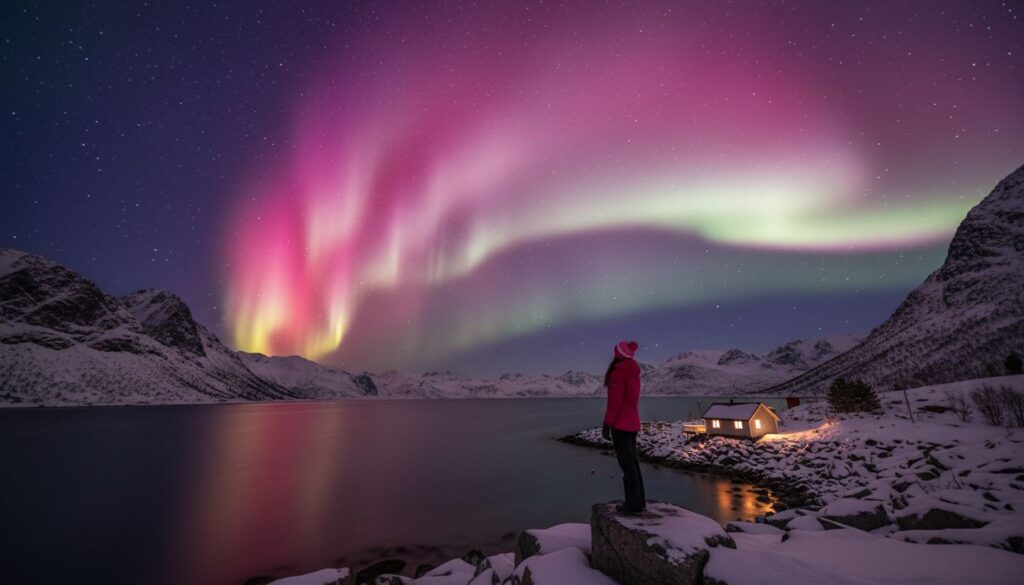
If your goal is to actually see the aurora, the best way to see the northern lights in Norway is usually not to pick one perfect viewpoint and hope for the best. It is to spend several nights in Northern Norway, stay close to the Arctic Circle, and keep your plans flexible enough to move when the clouds do. For most travelers, that means a base like Tromsø, plus either a guided chase, a coastal cruise, or enough time to drive out of town when conditions look promising. If you want more trip-planning ideas beyond aurora season, browse our Nordic travel inspiration.
The best way to see the northern lights in Norway

The shortest honest answer is this: the best way to see the northern lights in Norway is to give yourself several chances, not just one. That usually means a trip of at least three nights, ideally five to seven, in Northern Norway during the dark season. It also means choosing a method that lets you respond to weather, because clear skies matter just as much as aurora activity.
Here is how the main options compare.
| Travel style | Best for | Why it works | Trade-off |
|---|---|---|---|
| Guided aurora chase | First-timers, photographers, and anyone who does not want to drive | A local guide watches the weather, finds darker skies, and handles the logistics | You are on a schedule |
| Coastal cruise | Travelers who want convenience and flexibility | The ship can move toward better sky conditions and gives you multiple viewing nights | Less freedom to linger in one place |
| Self-drive | Independent travelers and multi-stop itineraries | You can leave city lights behind and adjust your route on the fly | Winter roads require confidence and good judgment |
| Staying in one city | Easy logistics and short breaks | Simple planning, good restaurants, and easy access to tours | Usually the lowest odds if you never leave the lights of town |
If I had to pick one approach for most visitors, it would be a flexible base in Tromsø or another Northern Norway hub, paired with one or more guided aurora nights. A cruise can be even better for travelers who want to unpack once and let the route do the work. Self-drive can be excellent too, but only if you are comfortable with winter driving and changing conditions.
A good rule of thumb is simple: the more nights you have, the better your chances. One clear night can turn into a lifetime memory, but a short trip leaves very little room for bad weather, weak activity, or plain bad luck.
Quick recommendation by travel style
- First-time visitor: Tromsø plus a guided chase.
- Best odds with minimal planning: A northern Norway cruise.
- Best for photographers: Five to seven nights, with flexible transport and dark-sky accommodation.
- Best for budget travelers: A city base with a couple of carefully chosen excursions.
- Best for independent road trips: Self-drive, but only if you are confident in winter conditions.
Why Norway works so well for aurora hunting
Norway is one of the strongest aurora destinations in the world for a few reasons. It sits far enough north to get you close to the auroral oval, the long Arctic nights give you plenty of darkness, and the country offers real travel infrastructure instead of a bare-bones expedition. That means you can chase the lights without giving up comfort completely.
The scenery helps too. Fjords, islands, mountain ridges, and fishing villages give the aurora a dramatic foreground, which makes the experience feel bigger than a simple sky show. In other words, Norway does not just increase your chances of seeing the lights, it makes the whole trip feel worth it even on the nights when the sky stays quiet.
When to go for the best odds

The aurora season in Norway generally runs from late September through early April, with the strongest travel window for many people falling between October and March. If you want the broadest mix of dark skies and better viewing opportunities, that is the season to target.
A simple way to think about timing:
- Late September to October: Great if you want the season to start early and do not mind slightly milder conditions.
- November to February: Excellent for long nights and classic winter scenery, though weather can be harsh and unpredictable.
- March to early April: Often a sweet spot for many travelers, with strong darkness, a good chance of clear nights, and slightly easier conditions.
For the nightly window, many visitors focus on the hours after dinner and before dawn. That said, the lights can appear whenever the sky is dark enough, so do not treat a time window as a guarantee. The real winning combination is darkness, clear skies, and enough patience to stay out.
Two more timing tips matter a lot:
- Stay at least three nights. One night is a gamble, two is still tight, three gives you a fair chance.
- Check the moon phase. A new moon or crescent moon can make photos look much more dramatic, although a brighter moon does not stop the aurora from appearing.
If you are building a larger Norway itinerary around the aurora season, our destination guides can help you compare Tromsø, Alta, Lofoten, and other northern bases.
Where to base yourself in Northern Norway
The best base depends on the kind of trip you want, but for most travelers, the sweet spot is somewhere in Northern Norway rather than Oslo or the far south. You want dark skies, easy access to aurora tours, and enough services to keep the trip comfortable.
Tromsø
Tromsø is the easiest all-around choice for many first-timers. It has good flight connections, plenty of tours, and quick access to darker countryside once you leave the city lights. If you want a balance of convenience and strong aurora chances, it is hard to beat.
Alta
Alta is a strong option if you want a slightly quieter feel and a trip that leans more toward the Arctic landscape. It is a good fit for travelers who like smaller places and do not mind a slower pace.
Lofoten
Lofoten is for travelers who care as much about scenery as they do about the aurora. The mountains and fishing villages are gorgeous, but coastal weather can be more changeable, so flexibility matters.
Lyngen
Lyngen is a favorite for people who want dramatic mountain backdrops and a more wilderness-focused trip. It pairs well with cabins, small lodges, and guided outdoor experiences.
Kirkenes and the far northeast
Kirkenes is a smart pick for travelers who want something more remote and less crowded. It is also a good base if you like the idea of adding winter activities and a quieter Arctic atmosphere.
North Cape and Honningsvåg
This area feels iconic and remote, which is part of the appeal. It works best for travelers who want a true edge-of-Europe atmosphere and do not mind a long journey.
If you stay in a city, try to sleep outside the brightest center if possible. Even a short drive away from streetlights can make a huge difference.
How to improve your chances once you are there

The biggest mistake people make is treating aurora viewing like a single attraction instead of a weather-sensitive hunt. Once you are in Norway, the goal is to stay alert, stay mobile, and stay out long enough for the sky to change.
Check two forecasts, not one
You want both aurora activity and cloud cover. A strong aurora forecast behind thick clouds does not help much, while a moderate forecast under clear skies can still produce a great display. Look for a forecast you can check daily, then recheck again after sunset.
Be willing to move
If your hotel window faces city lights, do not assume that is enough. Head to a darker place, join a chase, or drive to a lookout with less artificial light. The difference between an average viewing spot and a dark one can be huge.
Give yourself multiple chances
If the lights do not appear on the first night, that does not mean the trip failed. It often just means you need another try. This is why a longer stay matters so much.
Dress for standing still, not for walking
You are not hiking hard once the sky gets interesting. You are standing around in the cold, often for a long time, so dress warmer than you think you need to.
Do not ignore the moon
A bright moon can wash out weaker aurora and reduce contrast in photos. If you can choose dates, a darker moon phase is helpful. If you cannot, do not worry, you can still have a memorable sighting.
Avoid these common mistakes
- Booking only one night for a trip that is supposed to be about the aurora.
- Staying inside a bright city center the whole time.
- Assuming the best forecast on paper beats actual clear skies.
- Forgetting how cold it feels when you are standing still for an hour.
- Focusing so much on the camera that you forget to look up.
What to pack and how to photograph the aurora
To enjoy the night instead of just surviving it, pack like someone who plans to wait outside for a while. The right clothing matters almost as much as the forecast.
What to bring
- Thermal base layers
- A warm midlayer, such as fleece or wool
- An insulated winter jacket
- Waterproof boots with room for thick socks
- Gloves or mittens, plus a spare pair
- A hat that covers your ears
- A neck gaiter or scarf
- Hand warmers
- A headlamp with a red-light mode
- A fully charged power bank
If you are photographing the aurora, add:
- A tripod
- A camera with manual settings, if you use one
- Spare batteries, kept warm in an inner pocket
- A microfiber cloth for condensation or snow
Simple camera tips
- Use a wide-angle lens if you have one.
- Start with a wide aperture.
- Try an ISO between 800 and 3200, then adjust.
- Begin with a shutter speed around 5 to 15 seconds.
- Use manual focus, and focus on a distant bright point before the display begins.
- Shoot in RAW if possible.
For phone photos, use night mode or a long-exposure app if your device supports it. Keep the phone still, use a small tripod if you have one, and do not expect a handheld shot to compete with the real thing.
Sample itineraries for different travel styles
If you are planning around the aurora, the itinerary should support flexibility. Do not overpack the schedule with daytime activities that leave you exhausted at night.
3-day trip
Best for: travelers who are already in Northern Norway or short on time.
- Arrive in Tromsø or another northern base.
- Spend the first night on a guided chase or at a dark-sky viewpoint.
- Keep the second night free for another attempt.
- Use the third night as your backup in case weather ruins the first two.
This is the minimum trip I would recommend if the lights are your main goal.
5-day trip
Best for: first-timers who want a realistic chance without overcomplicating things.
- Base yourself in Tromsø or Alta.
- Book one guided aurora night right away.
- Leave at least one evening open for a second chase.
- Add daytime winter activities, but keep the nights light and flexible.
Five days gives you a much better balance between structure and spontaneity.
7-day trip
Best for: photographers, honeymooners, and anyone who wants to build a fuller Arctic trip.
- Start in Tromsø, then add a second base such as Lyngen, Lofoten, or Alta.
- Use one or two guided nights early in the trip.
- Keep the middle of the trip open for weather changes.
- Reserve your last night as a final aurora attempt.
If you like the idea of combining the aurora with fjords, fishing villages, and winter scenery, our travel inspiration pages can help you shape the rest of the route.
Frequently asked questions
Can you see the northern lights from Oslo?
Not reliably. Oslo is too far south for a proper aurora trip, so if seeing the lights is the goal, head north.
Is Tromsø enough for a northern lights trip?
Yes, absolutely. Tromsø is one of the most practical bases in Norway because it offers easy logistics and plenty of tours. If you have only a few nights, it is a strong choice.
Do you need a tour to see the aurora in Norway?
No, but it helps. A tour takes the guesswork out of weather, roads, and local viewing spots, which is useful if you do not want to manage everything yourself.
Is a cruise better than staying on land?
Sometimes. A cruise can be the easiest way to maximize your odds because it lets you move with the weather, but a good land-based trip with several nights can work just as well.
How many nights should you stay?
At least three, but five to seven is better if the northern lights are the reason you are going.
What is the single biggest factor for success?
Clear skies. Aurora activity matters, but clouds can ruin even a strong forecast. If you remember only one thing, remember that flexibility beats wishful thinking.
The best way to see the northern lights in Norway is to treat the trip like a chase, not a promise. Choose Northern Norway, give yourself several nights, stay flexible, and leave room in your schedule for the sky to surprise you. If you want help building the rest of the journey, start at Scandinavia Holiday and build a Norway trip that fits your pace.
Article created using Lovarank