If you want the best cities to see northern lights in Norway, the smartest approach is to rank them by more than latitude alone. The aurora depends on dark skies, weather, and how easily you can get out of town when clouds roll in. That is why the best city base for one traveler might be a lively hub with tours, while another person will be happier in a quieter Arctic town with less light pollution. This list balances both sides so you can choose a place that matches your style, your budget, and how much time you have. If you are planning a wider Nordic route, the destinations hub is a helpful place to start.
Some of the places below are technically towns rather than big cities, but they work as the best urban bases for aurora travel in Norway, which is what most travelers are really looking for.
| Rank | City | Why it stands out | Best for |
|---|---|---|---|
| 1 | Tromsø | Best all-around balance of access, tours, and dark-sky options | First-timers |
| 2 | Alta | Inland, quieter, and often easier to escape light pollution | Photographers |
| 3 | Kirkenes | Cold, dry winters and strong guided-tour options | Winter adventure |
| 4 | Longyearbyen | Polar-night drama and a truly remote Arctic feel | Bucket-list trips |
| 5 | Hammerfest | Less crowded and far north with dramatic viewpoints | Off-the-beaten-path travelers |
| 6 | Narvik | Easy mountain viewpoints and train-based aurora chasing | Scenic city breaks |
| 7 | Bodø | Accessible Arctic gateway with decent aurora potential | Short coastal add-ons |
1. Tromsø, the best all-around choice

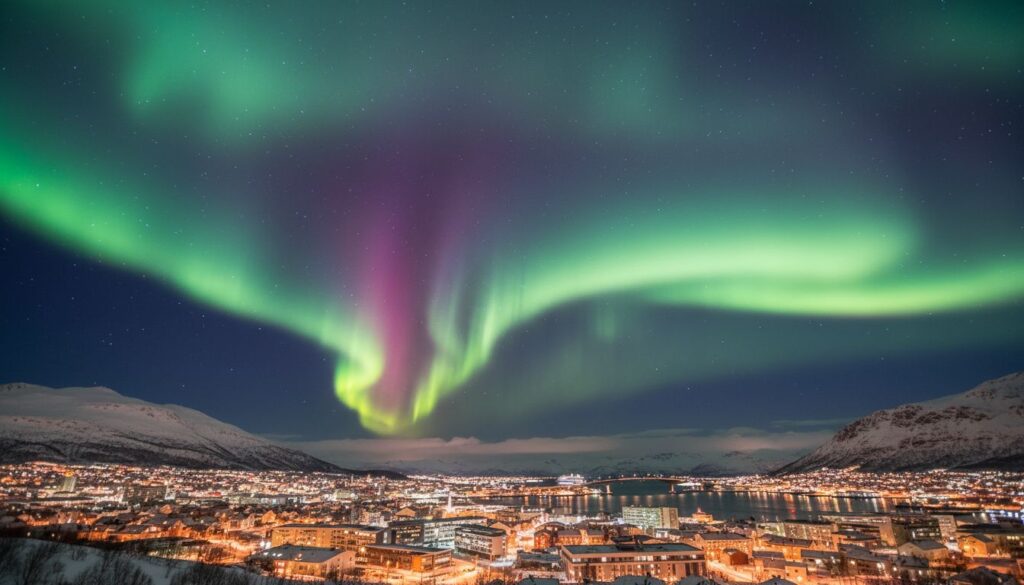
Tromsø is the safest answer for most travelers asking about the best cities to see northern lights in Norway. It has the right mix of aurora potential, easy logistics, and enough things to do that a cloudy night does not ruin the trip. You can sometimes spot the lights from darker parts of the city, but the better strategy is to head away from the center or join a local chase when the forecast looks promising.
A few of the most practical low-light spots near the center are the darker streets around Parkgata and the area by Prestvannet, which make Tromsø especially useful if you are short on time. That said, the city really shines because it gives you options. You can stay downtown for restaurants and museums, then move quickly to darker surroundings when conditions improve.
Best for: first-time aurora travelers, couples, and anyone who wants easy airport access plus a lively city base.
How long to stay: 3 to 4 nights is the sweet spot.
Why it ranks so high: if you want a trip that feels comfortable without sacrificing your chances, Tromsø is hard to beat.
For more winter trip ideas beyond aurora hunting, the inspiration page can help you build a fuller Arctic itinerary.
2. Alta, the best city for quieter skies
Alta does not always get the same attention as Tromsø, but it is one of the strongest choices if you want fewer crowds and a more low-key aurora trip. Being inland helps. The atmosphere often feels drier and calmer than many coastal destinations, and local safaris routinely leave the city behind to chase darker skies.
That matters more than people think. The northern lights are not only about being far north, they are about getting away from artificial light and finding a clear patch of sky. Alta makes that easy to understand, because the city itself is only the starting point. Once you are outside town, the landscape opens up fast.
Alta is also a strong pick for photographers. The combination of open space, darker edges of town, and guided trips that watch the forecast carefully gives you a real chance to work with the light instead of just hoping to see it from a sidewalk.
Best for: travelers who want a calmer Arctic base and better odds of escaping light pollution.
How long to stay: at least 3 nights, longer if you want to mix in daytime winter activities.
3. Kirkenes, the strongest choice for cold, clear winter conditions
Kirkenes is one of the best cities to see northern lights in Norway if you care about winter conditions more than nightlife. The local climate is a major advantage. Compared with many coastal places, it tends to have colder, clearer weather and less precipitation, which can make aurora viewing more reliable.
Tour operators in the area make the most of that setting. Evening safaris head into beautiful nature away from artificial light, and many trips are paired with other classic Arctic experiences such as king crab outings, snowmobile rides, dog sledding, or snowshoeing. That means you can build a trip that still feels full even if the sky takes a while to cooperate.
Kirkenes is a smart choice if you like a practical, weather-aware trip. It is less famous than Tromsø, but that is part of the appeal. You get a more remote feel without having to go fully off-grid.
Best for: winter travelers who want a quieter, colder, and more adventurous aurora base.
How long to stay: 2 to 4 nights, depending on how much time you want for other Arctic activities.
4. Longyearbyen, the most dramatic Arctic experience

Longyearbyen is not the easiest aurora base on this list, but it may be the most unforgettable. In Svalbard, the northern lights season runs from October through March, and from November the area enters polar night, which means the sun stays below the horizon all day. That gives you a very different kind of Arctic darkness to work with.
The big advantage here is atmosphere. Longyearbyen feels remote in a way few other places in Norway can match. Guided tours often drive out of town and away from the light pollution to find the best viewing spots, so the experience feels like a true expedition rather than a standard city break.
If you want a trip that is about more than just ticking off the aurora, Longyearbyen is the one to choose. The tradeoff is cost and remoteness, but for many travelers that is exactly what makes it special.
Best for: bucket-list travelers, photographers, and anyone who wants a raw Arctic setting.
How long to stay: 3 nights or more if you want a realistic shot at clear weather.
5. Hammerfest, the underrated far-north city
Hammerfest is a good reminder that the best aurora bases are not always the most famous ones. As the world’s northernmost town of its size, it has a strong Arctic identity and a dramatic setting on the coast. It is also less crowded than Tromsø, which makes it appealing if you prefer a quieter trip.
One of the best viewpoints is the Salen hill area, where you can look out over the surrounding landscape and enjoy the city from above. That elevated perspective is especially nice on a clear winter night, when the light from town becomes part of the scene instead of a distraction.
Hammerfest works best for travelers who want a real northern atmosphere without a heavy tourism feel. You will not find the same range of activities as in Tromsø, but you may appreciate the simpler pace.
Best for: off-the-beaten-path travelers and repeat visitors to northern Norway.
How long to stay: 2 to 3 nights is usually enough unless you are building a broader Finnmark trip.
6. Narvik, the best city for viewpoints and easy escapes from town
Narvik offers a very practical kind of aurora trip. You get a city base, mountain views, and easy access to darker elevations without needing to go deep into the wilderness. The cable car up Narvikfjellet is a big part of the appeal, because it gives you an elevated starting point for winter views and aurora hunting.
Narvik also has a train-based northern lights chase along the historic Ofoten Railway, which is a clever option for travelers who want something different from a standard minibus tour. In practice, that means you can combine the lights with fjord scenery, mountain air, and a strong sense of place.
This is a great city if you want your aurora trip to feel active but not overly remote. It is less famous than Tromsø and less extreme than Svalbard, but it delivers a memorable mix of convenience and scenery.
Best for: travelers who like scenic viewpoints, mountain settings, and easy tour access.
How long to stay: 2 to 3 nights.
7. Bodø, the easiest Arctic gateway on the list

Bodø is not the strongest aurora city on this list, but it earns a place because it is a practical Arctic gateway. It sits just above the Arctic Circle, which means northern lights are absolutely possible, especially if you get away from the city lights and into the surrounding countryside after dark.
Bodø is a good fit if you want a shorter trip, a coast-based itinerary, or a stop that is easy to combine with other places in Northern Norway. The city itself gives you more flexibility than a remote village, and local operators often focus on chasing clear skies once conditions look promising.
If your main goal is maximum aurora odds, choose Tromsø, Alta, or Kirkenes first. If your goal is an easier trip that still gives you a real shot at the lights, Bodø makes sense as a smart add-on.
Best for: short breaks and broader Northern Norway itineraries.
How long to stay: 2 to 3 nights.
When to go for the best chance of seeing the northern lights
The best time to see northern lights in Norway is usually from September to April. That is the season when the nights are dark enough to give you a real chance, and it lines up with the months most aurora travelers already plan around. If you want the strongest combination of dark skies and activity, the shoulder periods, especially September to October and March to April, are often excellent.
Winter is still a great choice, especially December through February, but the weather can be cloudier in some places. The key point is that cloud cover often matters more than latitude. A slightly less northerly city with clear skies can easily beat a farther-north destination that is buried under clouds.
Most sightings happen late at night, often between 11 p.m. and 2 a.m., so plan your evenings accordingly. It is also smart to book at least three nights. Four or five gives you much better odds.
How to make any of these cities work better
No matter which city you choose, a few habits will improve your chances.
- Stay flexible. If a local guide says the sky is clearing an hour away, be ready to move.
- Choose a dark-sky base. A hotel slightly outside the center can make a surprising difference.
- Use guided chases. Local operators watch the forecast and know where to go when the wind shifts.
- Pack for standing still in the cold. Warm boots, layered clothing, gloves, and a hat matter more than most people expect.
- Bring a tripod if you want photos. The aurora often looks best in long exposure shots.
The safest formula is simple. Pick a strong base, stay long enough, and let the weather do the deciding.
FAQ about the best cities to see northern lights in Norway
What is the best city to see northern lights in Norway?
Tromsø is the best all-around choice for most travelers because it combines strong aurora potential with easy access, tours, and plenty to do in the daytime.
Is Tromsø or Alta better?
Tromsø is better for convenience and first-time visitors. Alta is better if you want a quieter, more relaxed base with easier access to darker surroundings.
Can you see the northern lights from a city center?
Sometimes, yes. Tromsø is the best example on this list, but you will usually get better results by moving to a darker edge of town or joining a tour.
How many nights do you need in Norway for northern lights?
Three nights is the bare minimum. Four to five nights is much better if seeing the aurora is your main goal.
Do you need a tour to see the northern lights?
Not always, but tours improve your odds because local guides follow the weather and know how to move quickly when conditions change.
If you want the best cities to see northern lights in Norway, start with Tromsø for ease, Alta for darker skies, and Kirkenes or Longyearbyen if you want a more remote Arctic feel. Then build the rest of the trip around weather, flexibility, and enough nights to let the sky cooperate. For broader Scandinavian route planning, start with Scandinavia Holiday.
Article created using Lovarank