Yes, northern lights are 100% real. What most people mean when they ask "are northern lights real" is not whether the phenomenon exists but whether the bright, dramatic photos online match what you can actually see with your eyes. This article answers that question clearly, explains the science, debunks modern myths, and shows how scientists and citizen observers verify auroras in real time.
Quick Answer: Yes, Northern Lights Are 100% Real
The short, plain answer is yes. Northern lights are an atmospheric and magnetic phenomenon caused by charged particles from the sun interacting with Earth. They have been recorded for centuries and observed by scientists using ground instruments, balloons, and satellites.

Why do people still ask if they are real? Rare visibility at lower latitudes, spectacularly edited photos on social media, and long-exposure photography that exaggerates color can all make people skeptical. The proof for auroras is robust: continuous scientific measurements, historical records across cultures, and live imaging from multiple independent sources.
What Are the Northern Lights? (The Science)
At their core, northern lights or aurora borealis are the visible result of charged particles from the sun colliding with atoms and molecules in Earths upper atmosphere. The chain of events looks like this:
- The sun constantly emits a stream of charged particles called the solar wind. During active periods the sun also releases denser bursts such as coronal mass ejections.
- When those particles reach Earth, the planet magnetic field funnels them toward the polar regions where field lines meet the atmosphere.
- Energetic electrons and protons collide with oxygen and nitrogen atoms at altitudes from about 80 to 300 kilometers.
- Those collisions excite atmospheric atoms which then emit light as they return to their normal energy state. Different gases and altitudes produce different colors.
Auroras concentrate in a ring around each magnetic pole called the auroral oval. That is why they are most common in high-latitude countries like Norway, Iceland, Finland, Canada, Alaska, and parts of Russia.
Why Do People Think Northern Lights Might Be Fake?
Skepticism has grown with social media and an abundance of dramatic images. Here are the main reasons people question authenticity:
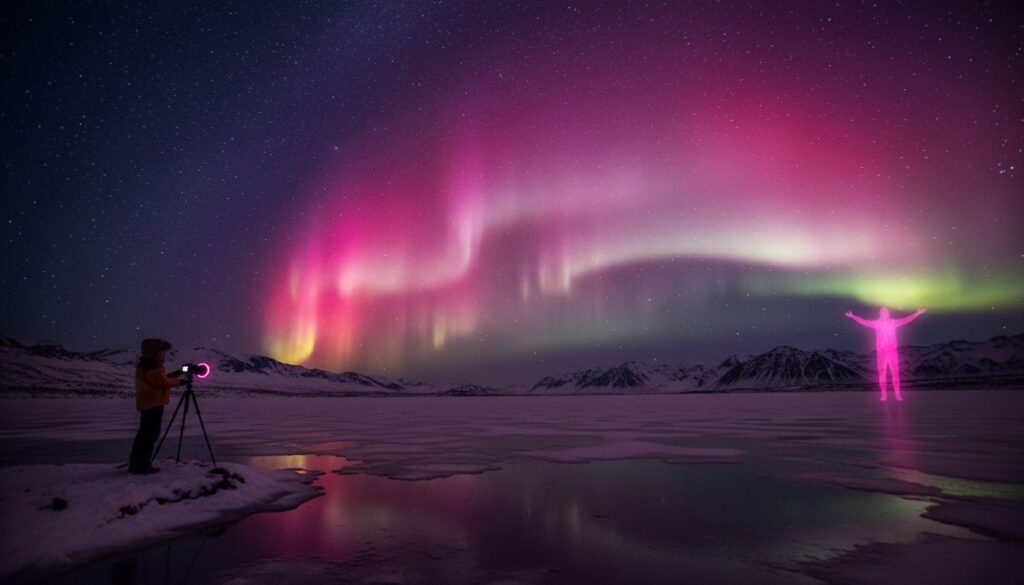
- Camera vs naked eye differences. Long-exposure photography collects more light over several seconds to minutes and records colors our eyes may not perceive in low-light conditions.
- Photo enhancement. Many online images have adjusted contrast, saturation, or HDR processing that make auroras look more vivid than they appeared.
- Viral fakes. Like any popular subject, aurora photos are occasionally edited or miscaptioned for clicks.
- Confusion with other lights. Ground lights, city glow, or even lasers can be mistaken for auroral activity in poor-quality images.
- Rarity in populated areas. People in cities rarely see auroras, so unfamiliarity breeds doubt.
Understanding these causes of doubt helps you evaluate images and eyewitness accounts more fairly.
Scientific Proof That Auroras Are Real
If you want evidence beyond eyewitness stories, there is plenty:
- Satellites continuously monitor charged particles and magnetic activity around Earth. Missions like NOAA GOES, ESA and NASA spacecraft record solar wind conditions that predict aurora activity.
- Space-based imaging. Satellites such as NASA TIMED and the Polar spacecraft have taken photographs of auroras from orbit showing the full oval.
- Ground-based instruments. Magnetometers, all-sky cameras, and specialized spectrographs operated by observatories record auroral energy, frequency, and color spectrum.
- Historical records. Written observations reach back centuries in Europe, Asia, and indigenous oral histories across the Arctic. These multiple independent records confirm consistent auroral behavior.
- Simultaneous multi-site observations. Strong geomagnetic storms produce auroras seen by thousands of observers around the same time across wide regions. Correlating these observations with satellite data removes reasonable doubt.
Northern Lights: Camera vs. Reality
One of the biggest sources of confusion is how cameras portray auroras compared to what the eye sees.
What you see with your naked eye
- Often subtle. At the edge of the auroral oval, lights can appear as faint grayish curtains or a gentle glow.
- Movement and structure. Your eye detects motion and sweeping shapes better than color in low light.
- Color depends on intensity. Bright green is common and often visible. Faint red or purple requires strong activity and a dark sky.
What a camera captures
- Long exposures reveal more color and faint structures because the sensor accumulates light over time.
- Modern sensors and post-processing boost saturation and contrast which enhances perceived color.
- Lenses and ISO settings affect brightness and noise, making some photos look otherworldly.
So a gorgeous photo does not mean a fake. It can be a faithful long-exposure image. But it is also true that post-processing can exaggerate features.
How to Verify Aurora Sightings Are Real
If you see a photo or claim and want to check if a northern lights event actually happened, use these practical verification methods:
- Check real-time geomagnetic indices. Kp index and NOAA space weather alerts indicate global magnetic activity. A Kp of 5 or more usually produces visible auroras at high latitudes.
- Use aurora forecast maps. Services such as the NOAA Space Weather Prediction Center and specialized aurora forecast sites show where activity is likely.
- Watch live webcams. Many stations near the auroral oval stream all-sky camera footage. Seeing a live feed is a direct way to verify.
- Cross-check timestamps and location. If a photo claims an unusual location for auroras, confirm solar activity at that time with satellite logs.
- Citizen science platforms. Projects such as Aurorasaurus let people report sightings and verify them against others in the area.

Combining these tools gives strong independent confirmation. For travellers planning a trip, consult local aurora webcams and forecasts a few nights ahead.
Common Northern Lights Myths Debunked
Myth 1: All aurora photos are fake
Reality: Many photos are genuine long-exposure images. However, some images are enhanced or miscaptioned. Verify with live data when in doubt.
Myth 2: Auroras are always bright and colorful
Reality: Intensity varies. Sometimes auroras are a faint glow or thin bands. Only during strong geomagnetic events do colors become vivid across wide areas.
Myth 3: You can only see them in winter
Reality: Darkness is the key, not cold. You can see auroras in summer at high latitudes during clear, dark nights. In mid-summer polar regions there may be no true night.
Myth 4: They make loud, audible sounds
Reality: Reports exist of sounds like faint crackling, but scientific evidence is inconclusive. Most auroras are silent because they occur far above the ground.
Myth 5: They are rare and almost impossible to see
Reality: In the auroral oval they are common. Outside those zones they are rarer but still occur during strong solar storms.
What Colors Are Real? (Aurora Color Guide)
Aurora colors come from which atmospheric gas is struck and at what altitude.
- Green: Most common. Caused by oxygen about 100 to 250 kilometers up. Green is often visible to the naked eye.
- Red: From oxygen at higher altitudes above 200 kilometers. Red is faint and less commonly seen without a camera.
- Blue and purple: From ionized nitrogen and seen during strong activity or in long-exposure photos. Blue can appear along the lower edges of auroral curtains.
- Pink and magenta: A mix of red and blue emissions, often visible in photos or during intense displays.
Remember that human night vision favors contrast and motion over color, so some colors recorded by cameras may be subtle to your eyes.
Where and When to See Real Northern Lights
Best locations
- Countries inside or near the auroral oval include northern Norway, Sweden, Finland, Iceland, northern Canada, Alaska, Greenland, and parts of Russia.
- Cities in these regions often suffer light pollution. For the best view choose rural locations away from urban lights.
Timing and conditions
- Solar cycle matters. The sun follows roughly an 11-year cycle of activity. Solar maximum years produce more frequent strong auroras.
- Nighttime darkness and clear skies are essential. Avoid full moonlight and cloud cover.
- Peak hours tend to be between 10 pm and 2 am local time, but strong storms can produce visible auroras any time of night.
Practical trip planning
- Plan a multi-night stay to increase your chances. Even in ideal locations auroras can be elusive.
- Use local tours and guides who monitor conditions and take you to dark vantage points.
- For ideas on where to go in Scandinavia and what experiences to book, see Aurora viewing destinations in Scandinavia. This resource lists top spots and practical travel tips.
Historical Evidence of Northern Lights
Auroras feature in ancient records from Asia, Europe, and North America. Indigenous Arctic communities have rich oral traditions describing the lights. Scientific observation intensified in the 17th and 18th centuries when systematic reports and the development of magnetometers connected auroras to magnetic disturbances. One famous historical event linked to solar activity is the 1859 Carrington Event which produced auroras visible at unusually low latitudes.
For readers interested in trip inspiration and cultural context for aurora watching, see the travel ideas and guides in our Inspiration for northern lights trips.
Are Aurora Photos Edited? How to Tell
Not all enhanced photos are dishonest. Photographers often use long exposures, which are legitimate. However, some signs suggest heavy editing or manipulation:
- Overly saturated colors that look unrealistic relative to surrounding scenes
- Mismatched shadows or lighting when foreground and sky exposures do not align
- Repeated patterns or cloned sections in the sky that suggest digital compositing
A quick cross-check against live webcams, Kp index records, and social media timestamps can usually tell you whether an extraordinary image matches real activity.
FAQs About Northern Lights Authenticity
Can you see them without a camera?
Yes. In the auroral oval and during strong storms, many observers report striking displays with their naked eyes. At the edge of the oval lights are often faint.
Do aurora photos always look like what you see in person?
Not always. Long exposures and processing enhance colors. Expect to see shapes and motion; colors may be subtler.
How bright are they really?
Brightness varies from faint glows to brilliant curtains that light up the landscape during intense geomagnetic storms.
Are auroras visible on other planets?
Yes. Planets with atmospheres and magnetic fields such as Jupiter and Saturn display auroras. NASA and ESA spacecraft have photographed them.
How can I check if an aurora is happening now?
Monitor Kp index forecasts, watch aurora webcams near the auroral oval, and check space weather alerts from NOAA or ESA. Citizen networks like Aurorasaurus also report real-time sightings.
Practical Tips for First-Time Observers
- Dress for the weather. Arctic nights are cold and clear nights can be bitter.
- Bring a tripod if you want photos. Use a wide aperture, high ISO, and multi-second exposure for better captures.
- Allow your eyes to adjust to the dark for at least 20 minutes.
- Keep expectations realistic. Sometimes the best displays are subtle and slowly evolving rather than dramatic ribbons.
If you want expert help planning an aurora trip, consider reaching out to local specialists who coordinate tours and night-time logistics. You can contact our travel experts for northern lights guidance to ask about timing, accommodations, and guided viewing options.
Final Thoughts
So when someone asks "are northern lights real" your answer can be confident: yes. The phenomenon is well established scientifically and visible to observers under the right conditions. Social media can stretch perceptions by showcasing long-exposure and edited images, but that does not negate the real, measurable, and often breathtaking displays that thousands of people see each year. With the right tools and expectations, you can verify an aurora sighting and, with luck, witness the lights yourself.
For background about the organization and resources that can help you plan a viewing trip, learn more about our mission and travel services.
Article created using Lovarank