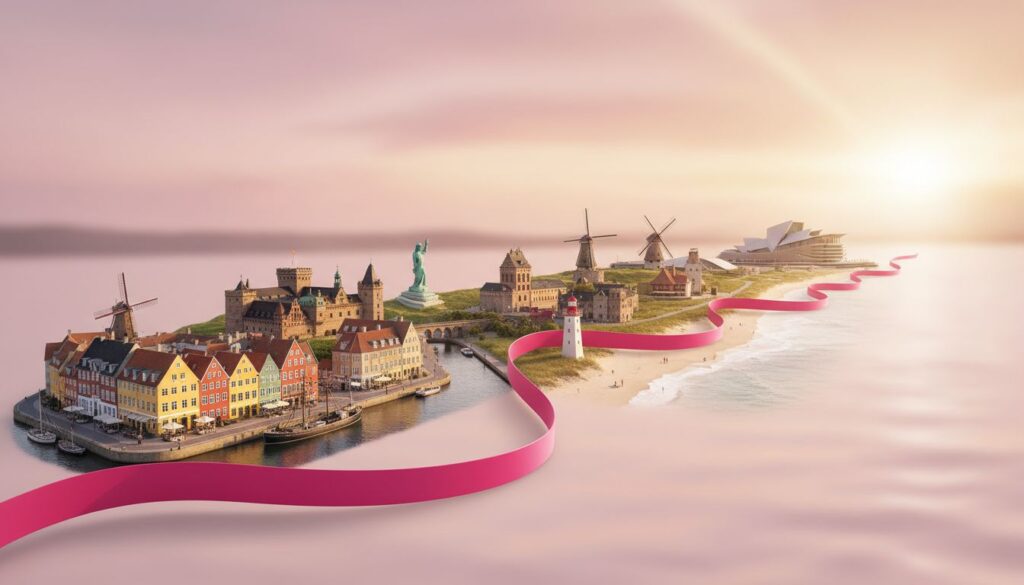
Denmark rewards travelers who mix the headline attractions with a few slower stops. The country has royal castles, Viking sites, modern art, and wild coastal landscapes, so the best trips usually move region by region instead of trying to do everything at once. If you are planning a broader Nordic route while you map out the top sites in Denmark, our Nordic travel guides and local experiences are a good place to start.
Below, you will find a practical list of the top sites Denmark visitors should not miss, grouped by region so you can turn ideas into an actual itinerary.
Copenhagen, Zealand, and the classic first stops

If you are short on time, this is the region where many first-time visitors start. It combines easy transport, big-name landmarks, and several places that work well in both good weather and rainy weather.
1. Tivoli Gardens
Tivoli Gardens is the classic first stop in Copenhagen because it combines rides, gardens, food, and evening atmosphere in one central place. The official site says it opens for 255 days a year and sits right next to Copenhagen Central Station, which makes it easy to slot into a short city break. If you only have one evening in the city, this is one of the easiest places to feel the energy of Denmark right away. (tivoli.dk)
2. The National Museum
If you want context before moving on to castles and coastlines, the National Museum is the place to start. It is right in the heart of Copenhagen and covers everything from Viking treasure and the Sun Chariot to the Egtved Girl and Egyptian mummies. It is a smart rainy-day stop, but it is also one of the strongest ways to understand Denmark before you travel farther. (visitdenmark.com)
3. Frederiksborg Castle
Frederiksborg is one of Denmark’s most famous castles for good reason. Set on three islands with a lake and formal gardens, it is the largest Renaissance castle in Scandinavia and is only about 40 minutes from downtown Copenhagen, which makes it an easy half-day trip. If you like royal history and photogenic scenery, this is an essential stop. (visitdenmark.com)
4. Kronborg Castle
Kronborg has the kind of drama you want from a Danish landmark. The castle is known worldwide as Hamlet’s Castle, it entered the UNESCO World Heritage List in 2000, and its fortifications once controlled the narrow stretch of water between Denmark and Sweden. Plan at least a few hours here, because the setting matters as much as the rooms inside. (visitdenmark.com)
5. Roskilde Cathedral
Roskilde Cathedral is not just beautiful, it is one of the most important buildings in Danish history. VisitDenmark calls it the country’s most important church, a royal mausoleum, and a UNESCO World Heritage Site, with forty kings and queens buried inside. It is an easy add-on if you are already exploring Zealand, and it gives real weight to the royal stories you will hear elsewhere. (visitdenmark.com)
6. Louisiana Museum of Modern Art
Louisiana proves that Denmark’s top sites are not only about old stone and royal stories. This leading modern art museum sits about 30 minutes from Copenhagen in Humlebæk, where art, nature, and architecture blend together along the Øresund shoreline. The sculpture park alone is worth the trip, especially if you want a slower, more reflective stop between big-ticket attractions. (visitdenmark.com)
7. Møns Klint
Møns Klint is one of Denmark’s most striking landscapes, and it earns a place on any list of the top sites in Denmark for pure scenery. UNESCO describes it as a dramatic glaciotectonic landscape with chalk cliffs, fossils, and rare habitats, while VisitDenmark points travelers toward GeoCenter Møns Klint as the natural place to learn more. Go for the views, but give yourself time for the trails too. (whc.unesco.org)
Funen and South Denmark for fairy tales, castles, and Viking roots

This is the best region for travelers who want a blend of storybook towns and easy family stops. If you want more ideas for shaping a broader route, our Scandinavia travel inspiration page is a good place to keep exploring.
8. Hans Christian Andersen House and the old town in Odense
Odense is the natural stop for anyone who wants to walk in Hans Christian Andersen’s footsteps. VisitDenmark notes that Andersen was born here, that the old town still preserves a medieval street pattern, and that the new Hans Christian Andersen House turns fairy tales into an immersive museum experience. Pair the museum with a stroll through the cobbled streets and you get one of the most atmospheric city breaks in Denmark. (visitdenmark.com)
9. Egeskov Castle
Egeskov is one of the best Denmark attractions if you are traveling with kids, but it is far from a kid-only stop. VisitDenmark describes it as one of Europe’s finest Renaissance buildings and highlights the moat, gardens, mazes, playground, and exhibitions of vintage cars, motorcycles, and dollhouses. It is the kind of place where a half day can quietly turn into a full one. (visitdenmark.com)
10. Christiansfeld
Christiansfeld deserves attention because it offers something very different from the more famous royal and coastal sites. This UNESCO-listed town was founded in 1773 by a Moravian congregation, and its buildings are still celebrated for how closely they preserve the original town plan. It is a good choice if you like quiet streets, architecture, and places that feel genuinely lived in rather than staged. (visitdenmark.com)
11. Jelling Monuments
Jelling is one of the most important Viking sites in the country, full stop. VisitDenmark says the site contains Denmark’s two largest burial mounds and rune stones from Gorm the Old and Harald Bluetooth, and the Jelling Monuments are part of the UNESCO World Heritage List. If you want a place that explains how Denmark became Denmark, put this near the top of your list. (visitdenmark.com)
12. LEGOLAND Billund Resort
LEGOLAND Billund is the easiest sell in Denmark if you are traveling with children, but the appeal goes well beyond one age group. VisitDenmark calls it the original LEGOLAND and points out that it is only a short drive from Billund Airport, with LEGO House, play spaces, and other family experiences nearby. If your trip needs one guaranteed crowd-pleaser, this is probably it. (visitdenmark.com)
13. Ribe
Ribe brings a slower, older layer to the top sites in Denmark. VisitDenmark describes it as the country’s oldest town, with about 1,300 years of history, charming streets, and a close connection to the Wadden Sea. It is the sort of place where the best plan is to wander, climb the cathedral tower, and let the mood of the town do the work. (visitdenmark.com)
Jutland, the coast, and the islands

Jutland and the islands are where Denmark gets wilder, broader, and more open. If you like art, seabirds, dunes, and quieter horizons, this is the region that will probably stay with you longest.
14. ARoS Aarhus Art Museum
ARoS is one of the strongest reasons to spend time in Aarhus rather than just passing through. The museum sits in the center of the city, houses a large international collection, and is best known for Your rainbow panorama, the circular rooftop work that gives you a full-spectrum view over Aarhus. It is a solid pick for travelers who want a modern, urban counterpoint to castles and coastlines. (visitdenmark.com)
15. Wadden Sea National Park
The Wadden Sea is the place to go when you want to understand Denmark’s coastal wild side. VisitDenmark calls it one of the world’s top ten tidal flats, and the area is also a UNESCO World Heritage Site. Between the shifting mudflats, birdlife, seal populations, and vast open horizons, this is one of the country’s best nature experiences. (visitdenmark.com)
16. Skagens Museum and Grenen
Skagen gives you both art history and landscape drama in one stop. The museum holds the world’s largest collection of Skagen painters, while Grenen lets you stand at Denmark’s northern tip and watch the Skagerrak and Kattegat meet. That combination of cultural heritage and raw coast is exactly why Skagen belongs on a top-sites list. (visitdenmark.com)
17. Aalborg Zoo
Aalborg Zoo is a strong family stop in northern Jutland, especially if your itinerary needs something easy and practical after museums and castles. VisitDenmark says it is open 363 days a year and has more than 100 species, so it works well in almost any season. It is not the most famous attraction on this list, but it is one of the most straightforward wins for families. (visitdenmark.com)
18. Hammershus and Hammerknuden, Bornholm
Bornholm is Denmark’s sunshine island, and Hammershus is its headline ruin. VisitDenmark describes Hammershus as Northern Europe’s largest castle ruin, while Hammerknuden adds dramatic cliffs, lighthouses, and hiking trails that show the island at its most rugged. If you want a final stop that feels different from the mainland, this is a great one. (visitdenmark.com)
How to build the best Denmark itinerary from these sites
If you are planning a first trip, do not try to squeeze in everything. A smarter approach is to pick one base in Copenhagen or Zealand, one stop in Funen or South Denmark, and one wider Jutland or coastal experience. That keeps the trip balanced and cuts down on backtracking.
- 3 to 4 days: Focus on Tivoli Gardens, the National Museum, Frederiksborg Castle, and either Kronborg or Roskilde.
- 5 to 7 days: Add Odense, Egeskov Castle, Jelling, ARoS, and one nature stop like Møns Klint or the Wadden Sea.
- 8 to 10 days: Go farther with Ribe, Skagen, Aalborg, and Bornholm for a fuller picture of the country.
For a broader mix of route ideas, our destination guides can help you turn a shortlist into a real plan.
FAQ about the top sites in Denmark
What are the top sites in Denmark for first-time visitors?
A first-timer can get a strong overview with Tivoli Gardens, the National Museum, Frederiksborg Castle, Kronborg Castle, Roskilde Cathedral, and one scenic stop such as Møns Klint or the Wadden Sea. (tivoli.dk)
What are the best top sites in Denmark outside Copenhagen?
Odense, Egeskov Castle, Jelling, Ribe, Aarhus, Skagen, and Bornholm are some of the strongest options if you want to leave the capital behind. (visitdenmark.com)
What are the top sites in Denmark for families?
LEGOLAND Billund, Tivoli Gardens, Egeskov Castle, Aalborg Zoo, and the H.C. Andersen House are all especially easy to enjoy with children. (visitdenmark.com)
How many days do you need to see Denmark’s highlights?
With 5 to 7 days, you can cover Copenhagen plus one or two regional stops. With 10 days, you can move at a more relaxed pace and add coast, castles, and an island stop without feeling rushed.
What is the best month to visit Denmark?
Late spring through early autumn is usually the easiest time for castle gardens, coastal walks, and outdoor sightseeing. Winter can also be rewarding if you want to focus on museums, city breaks, and cozy indoor attractions.
Denmark is at its best when you mix the obvious icons with a few places that surprise you. Start with one or two of the big names, then add a castle, a coastal landscape, and a smaller town, and you will see why the top sites in Denmark fit so naturally into one memorable trip.
Article created using Lovarank