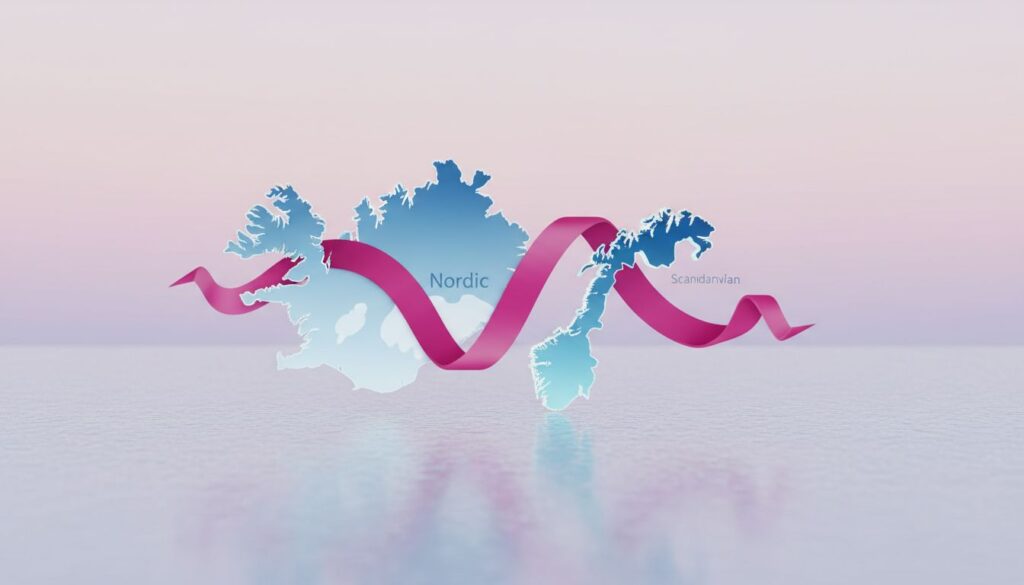
If you have ever wondered about the difference between Nordic and Scandinavian, you are not alone. The two terms get mixed up constantly, especially in travel writing, news articles, and casual conversation. The simplest way to separate them is this: Scandinavian usually means Denmark, Norway, and Sweden, while Nordic is broader and also includes Finland and Iceland, plus some associated territories in certain official contexts. In other words, Scandinavia is the smaller circle, and the Nordic region is the larger one.
The short answer
| Category | Scandinavian | Nordic |
|---|---|---|
| Core meaning | Denmark, Norway, Sweden | Denmark, Norway, Sweden, Finland, Iceland |
| Scope | Narrower | Broader |
| Geography | Linked to the Scandinavian Peninsula and nearby cultural areas | Northern Europe plus the North Atlantic and Arctic connections |
| Language | Usually North Germanic languages | Mix of North Germanic, Finnic, and other regional languages |
| Common use | Culture, history, geography, language | Regional cooperation, politics, travel, broader identity |
| Safe default | Use when you mean the three countries only | Use when you mean the whole region |
That is the version most people need. If you are writing for a general audience, or planning a trip across the region, Nordic is often the safer term because it is less likely to be wrong.
What “Scandinavian” means

In everyday English, Scandinavian most often refers to Denmark, Norway, and Sweden. That is the standard, widely accepted meaning. The term is closely tied to history, language, and geography, and it is often used when people are talking about the Scandinavian Peninsula, North Germanic languages, or shared cultural traditions.
There is one important wrinkle. Denmark is usually included in Scandinavia even though most of the country is not on the Scandinavian Peninsula. That is because the term is not only geographic. It is also historical and cultural. So when people say Scandinavian, they usually mean a shared regional identity, not just a strict map boundary.
If you want the shortest rule possible, use Scandinavian for Denmark, Norway, and Sweden. If someone includes Finland or Iceland in that group, they are usually using the term loosely, not in its narrowest sense.
What “Nordic” means
Nordic is the broader regional term. It usually includes the five sovereign states of Denmark, Finland, Iceland, Norway, and Sweden. In some official or institutional settings, the wider Nordic region also includes the Faroe Islands, Greenland, and Åland.
That broader scope is what makes Nordic the better term when you are talking about regional cooperation, public policy, travel across several countries, or shared institutions such as the Nordic Council and the Nordic Council of Ministers.
If you are building an itinerary or comparing places across the region, our Nordic destinations guide is a useful place to start. It gives you a wider view of the region than a country-by-country list alone.
Nordic is also the term you will see in many official and administrative contexts because it covers the full regional partnership rather than just the three core Scandinavian countries.
Why people confuse the two terms

The confusion makes sense. The two terms overlap in real life, and they share a lot of history.
First, the countries are close neighbors with strong cultural and political ties. Second, the languages are related in the Scandinavian core countries. Third, international media and tourism often use Scandinavia as a shorthand for the whole northern region because it sounds familiar and simple.
That casual shorthand is part of the problem. In a headline, brochure, or blog post, “Scandinavia” is sometimes used to mean the entire Nordic region, even when the writer really means the broader grouping. It is not always wrong in everyday speech, but it is less precise.
If you are planning a trip and want ideas that reflect the wider region rather than just the three-country core, browse our Scandinavia travel inspiration. The difference between the terms matters less when you are booking a vacation, but it matters more when you want to write or speak accurately.
A brief history of the names

The reason the terminology feels so blurred is that the history behind it is blurred too.
The idea of Scandinavia became especially important in the 19th century, when intellectuals and political thinkers promoted the idea of cultural unity among Denmark, Norway, and Sweden. This was tied to language, literature, and shared political interests. Over time, the word became associated not just with geography, but with a wider regional identity.
The idea of Nordic cooperation developed more clearly in the 20th century, especially after World War II. The Nordic Council, founded in 1952, created a formal space for cooperation between the countries of the region. That helped the term Nordic become the broader umbrella word for collaboration, institutions, and regional identity.
So historically, the terms evolved for different reasons. Scandinavian grew out of a narrower cultural and geographic idea. Nordic became the larger political and cooperative label.
Country-by-country guide
Here is the practical breakdown most readers want.
Denmark
Denmark is Scandinavian and Nordic.
Norway
Norway is Scandinavian and Nordic.
Sweden
Sweden is Scandinavian and Nordic.
Finland
Finland is Nordic, but usually not Scandinavian.
Iceland
Iceland is Nordic, but usually not Scandinavian.
Faroe Islands
The Faroe Islands are part of the broader Nordic sphere, but they are not usually called Scandinavian.
Greenland
Greenland is part of the broader Nordic institutional context, but it is not usually called Scandinavian.
Åland
Åland is also part of Nordic cooperation, but it is not usually called Scandinavian.
A simple way to remember it is this: if the list has three countries, you are probably in Scandinavia. If the list has five countries or more, you are probably in the Nordic region.
Language, geography, and culture
Language is one of the biggest reasons these terms stay confusing.
The Scandinavian core languages, Danish, Norwegian, and Swedish, belong to the North Germanic language family. They are closely related, and speakers can often understand one another at least partly, especially in written form. That linguistic closeness is one reason the three countries are so often grouped together.
But the Nordic region is broader than language alone. Finnish is not a North Germanic language. It belongs to a different language family. Icelandic and Faroese are North Germanic, but they are more conservative and less mutually intelligible with the mainland Scandinavian languages than Danish, Norwegian, and Swedish are.
Geography also matters. Scandinavia is often associated with the Scandinavian Peninsula, while the Nordic region spreads beyond that into the North Atlantic and the Arctic. That is why Nordic is better when you are describing the whole regional picture.
Culturally, the countries share a lot, but they are still distinct. They have different histories, political systems, and national identities. The shared features, such as social trust, design traditions, welfare systems, and strong public institutions, are real, but they do not erase the differences. If you want a broad cultural label, Nordic is usually the better fit.
For readers who want a broader look at the region behind the travel pages, our about page explains more about how Scandinavia Holiday approaches northern travel and local experiences.
When to use each term
If you are not sure which word to choose, use these simple rules:
- Use Scandinavian when you mean Denmark, Norway, and Sweden.
- Use Nordic when you mean Denmark, Finland, Iceland, Norway, and Sweden.
- Use Nordic when talking about regional cooperation, shared institutions, or mixed-country travel routes.
- Use Scandinavian when talking about the Scandinavian Peninsula, Scandinavian languages, or cultural traditions tied to the three-country core.
- If you are unsure, Nordic is usually the safer choice because it is broader and less likely to exclude a country by mistake.
That last point is especially useful in travel, publishing, and business writing. A phrase like “Nordic cities” or “Nordic travel” is usually more accurate if your content covers Finland or Iceland. A phrase like “Scandinavian design” makes sense when you are specifically referring to the style associated with Denmark, Norway, and Sweden.
Frequently asked questions
Is Finland Scandinavian?
No, Finland is usually considered Nordic, not Scandinavian. Some people use Scandinavian loosely to include it, but that is not the standard definition.
Is Iceland Scandinavian?
No, Iceland is usually Nordic, not Scandinavian. It is part of the broader Nordic region, but not the narrow Scandinavian core.
Is Denmark Scandinavian or Nordic?
Denmark is both Scandinavian and Nordic.
Is Norway Scandinavian or Nordic?
Norway is both Scandinavian and Nordic.
Is Sweden Scandinavian or Nordic?
Sweden is both Scandinavian and Nordic.
Are the Faroe Islands, Greenland, and Åland Scandinavian?
Usually no. They are often included in Nordic contexts, especially institutional ones, but they are not usually described as Scandinavian.
What is the difference between Nordic and Scandinavian in one sentence?
Scandinavian usually means Denmark, Norway, and Sweden, while Nordic is the broader group that also includes Finland and Iceland, plus some associated territories in official contexts.
Which term should I use in a travel article?
If your article includes only Denmark, Norway, and Sweden, use Scandinavian. If it includes Finland or Iceland, or you want a broader regional term, use Nordic.
The difference between Nordic and Scandinavian is mostly a matter of scope. Scandinavian is the narrower, more specific term, while Nordic is the broader regional umbrella. Once you keep that simple rule in mind, the confusion disappears fast.
Article created using Lovarank