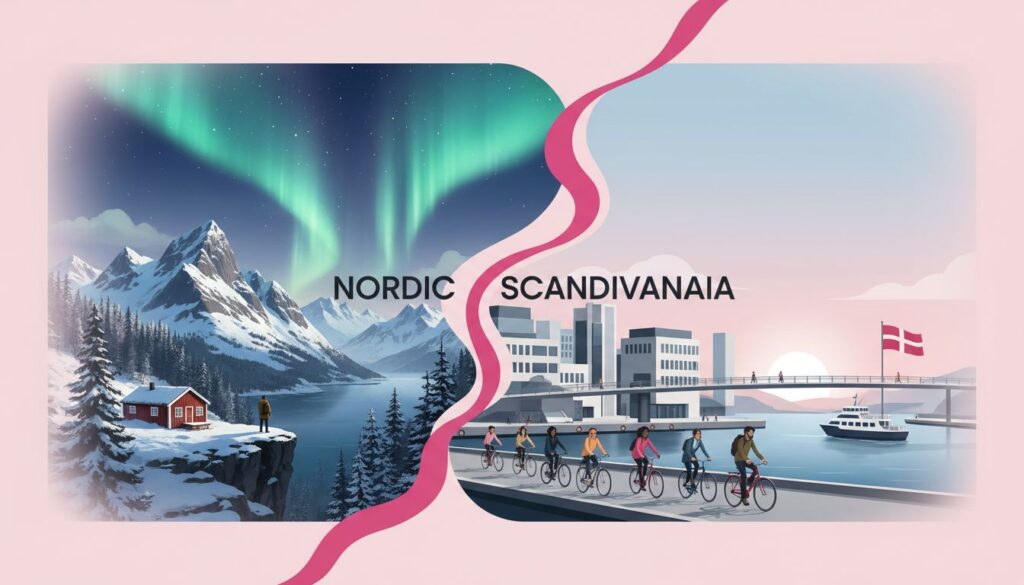
People often use Nordic and Scandinavian as if they mean the same thing, but they do not. In everyday English, Scandinavia usually refers to Denmark, Norway, and Sweden, while Nordic is the broader regional term that also includes Finland and Iceland. That simple split solves most of the confusion, whether you are reading a map, planning a trip, or trying to describe a culture accurately.
Nordic vs Scandinavia at a glance
| Topic | Nordic | Scandinavian |
|---|---|---|
| Core countries | Denmark, Norway, Sweden, Finland, Iceland | Denmark, Norway, Sweden |
| Main idea | Broader Northern European region | Narrower historical and cultural region |
| Language mix | North Germanic languages plus Finnish and related minority languages | Mostly the North Germanic languages of Denmark, Norway, and Sweden |
| Common use | Politics, geography, travel, culture | Geography, language, history, casual shorthand |
This is the simplest way to remember it: if Finland or Iceland are included, the term should usually be Nordic. If the group stays with Denmark, Norway, and Sweden, Scandinavian is the tighter fit.
If Finland or Iceland are in the conversation, say Nordic. If it is only Denmark, Norway, and Sweden, say Scandinavian.
What Scandinavia means

Scandinavia is the narrower of the two labels. Most people use it to mean Denmark, Norway, and Sweden together, especially when they are talking about shared history, related languages, or a region that feels culturally connected. In that everyday sense, Scandinavia is the classic trio many readers picture first.
There is also a stricter geographic use of the word. Some people connect Scandinavia to the Scandinavian Peninsula, which is centered on Norway and Sweden. That is where the terminology gets slippery, because the geographic label and the cultural label do not always overlap perfectly. Denmark is part of Scandinavia in the cultural sense, even though it is not on the peninsula.
That is why you will sometimes hear the term used a little loosely. In travel writing, general conversation, and even marketing, Scandinavia often works as a shorthand for the three-country core. Just remember that it is the narrower term.
Scandinavia also carries a strong sense of identity. When people say Scandinavian design or Scandinavian style, they usually mean a look associated with Denmark, Norway, and Sweden. The phrase has become so familiar that many people use it without stopping to think about the exact borders.
What Nordic means
Nordic is the broader umbrella. It covers Denmark, Norway, Sweden, Finland, and Iceland, and it is the safest term when you want to include the full modern regional group. In official cooperation, public policy, and many travel contexts, Nordic is the better word because it does not leave Finland or Iceland out of the picture.
The Nordic label is also useful because it captures a shared regional identity without pretending every country is identical. Denmark, Norway, Sweden, Finland, and Iceland are linked by history and cooperation, but they still have different languages, landscapes, and national stories. Nordic lets you talk about the group as a whole without flattening those differences.
If you are looking at the region from a traveler’s point of view, Nordic is especially practical. It works for country-hopping itineraries, broader cultural comparisons, and destinations that go beyond the traditional Scandinavian trio. It is also the word that keeps your writing accurate when Finland or Iceland are part of the picture.
Why people confuse the two

The confusion is understandable because the region shares a lot of history. Denmark, Norway, and Sweden have been tied together for centuries through kingdoms, unions, trade, and migration. Their languages are closely related, their histories overlap, and their cultural references often blend into one another.
That is why Scandinavian gets used as a kind of default label. People hear Scandinavian design, Scandinavian furniture, or Scandinavian crime fiction and start using the word for almost anything northern and stylish. It becomes a convenient shorthand, even when the broader Nordic label would be more accurate.
A lot of the overlap also comes from the way outsiders learn the region. If someone first encounters the area through tourism, home design, or food, they may hear Scandinavian more often than Nordic. Once that habit starts, the distinction can feel smaller than it really is.
Language is the clearest clue
Language is one of the easiest ways to tell the terms apart. Danish, Norwegian, and Swedish are usually the Scandinavian languages. They all belong to the North Germanic branch and are close enough that speakers can often recognize parts of one another’s language.
Icelandic and Faroese are also North Germanic languages, but they are not usually part of the everyday Scandinavian trio. Finnish is different again. It belongs to another language family entirely, which is one reason Finland is Nordic but not typically Scandinavian.
So if the conversation is about language, Scandinavian is usually the narrower term and Nordic is the broader one. That is especially helpful in travel or culture writing, where the language mix often tells you exactly which label fits best.
Geography is the other clue
Geography adds another layer. Scandinavia is tied to a narrower historical and geographic core, often associated with the Scandinavian Peninsula and the three-country cultural zone around it. Nordic stretches wider across the region and works better when you are grouping countries around the North Atlantic and northern Europe more broadly.
If you want a safe rule, think of Nordic as the umbrella and Scandinavia as the inner circle. That one mental picture makes the difference much easier to remember.
Which countries fit where?
| Country or territory | Nordic | Scandinavian | Quick note |
|---|---|---|---|
| Denmark | Yes | Yes | A core member of both labels |
| Norway | Yes | Yes | One of the clearest Scandinavian examples |
| Sweden | Yes | Yes | Often the default reference point for Scandinavia |
| Finland | Yes | No | Nordic, but not usually Scandinavian |
| Iceland | Yes | No | Nordic through history and cooperation |
| Greenland | Often included in broader Nordic discussions | No | Usually treated as part of the wider Nordic sphere |
| Faroe Islands | Often included in broader Nordic discussions | No | Frequently discussed with the Nordic region |
| Åland | Often included in broader Nordic discussions | No | Commonly linked to Nordic cooperation |
Denmark, Norway, and Sweden are the easy cases. Finland is the test case. Iceland is the edge case. The territories are the nuance. That is why a quick chart saves so much confusion.
This is also where the difference matters for travel planning and content writing. If you are describing a trip that includes Finland or Iceland, Nordic is the safer label. If your focus stays on Denmark, Norway, and Sweden, Scandinavian feels more precise.
If you are comparing where to go next, our destination guides are a handy way to see how each country feels on the ground.
How the terms show up in travel, culture, and business

In travel writing, Nordic is often the more flexible word. It lets you talk about a trip that includes Copenhagen, Oslo, Stockholm, Helsinki, and Reykjavik without changing the label every time the route shifts. That is why broader itineraries are often described as Nordic trips rather than Scandinavian ones.
Scandinavian still has a strong place in culture and branding. It is common in design, architecture, food, and lifestyle writing, especially when the focus is on the clean, minimal aesthetic that many readers associate with the region. Nordic is more common when the topic is cooperation, politics, economics, or the shared regional model behind the headlines.
In business and media, the distinction matters because it changes the scope of the story. A Scandinavian product launch usually implies Denmark, Norway, and Sweden. A Nordic market report suggests a wider audience that includes Finland and Iceland too.
You can also think about it this way: Scandinavian often sounds more specific, while Nordic often sounds more inclusive. When in doubt, inclusive is usually the better choice if your audience might interpret the narrower term too literally.
If you want more trip ideas across that wider region, our Nordic travel inspiration page is a good place to start.
Related terms you may also see
Northern Europe is broader than Nordic and can include places outside the core Nordic group depending on the source. That is why it is not a clean substitute for either term. Fennoscandia is another word people sometimes mix in, but it is a geographic and geological label, not a cultural one.
A simple way to picture the relationship is this: Scandinavia is the smaller circle, Nordic is the larger circle around it, and Northern Europe is the even broader regional label that sits outside both. Once you see the nesting, the terminology becomes much easier to follow.
It also helps to remember that regional labels are used differently depending on context. A geographer, a historian, a travel writer, and a marketer may all use the same word a little differently. That is normal, which is why it helps to choose the tightest term that still includes everyone you mean.
FAQ
Are Nordic and Scandinavian the same?
No. Scandinavian is narrower. Nordic is the broader regional term.
Is Finland Scandinavian?
No. Finland is Nordic, but not usually Scandinavian.
Is Iceland Scandinavian?
No. Iceland is Nordic, but not usually Scandinavian.
Is Denmark Nordic or Scandinavian?
Both. Denmark is part of the Scandinavian core and the wider Nordic region.
Are Greenland, the Faroe Islands, and Åland Nordic?
They are often included in broader Nordic discussions, especially in cultural and political contexts, even though they are not independent countries in the usual sense.
Are the Baltic countries Nordic?
No, not in the standard regional sense. They are usually discussed separately.
Should I say Nordic or Scandinavian when I talk about a trip?
Use Nordic if your trip includes Finland or Iceland, or if you want a broader regional label. Use Scandinavian if you are focusing on Denmark, Norway, and Sweden only.
Is Scandinavia part of Nordic?
Yes. Scandinavia is usually considered the smaller core inside the larger Nordic region.
What about the Scandinavian Peninsula?
That is the geographic version of the term, and it is narrower than the cultural use. It helps explain why Denmark can be Scandinavian even though it is not physically on the peninsula.
The simplest way to remember it
The easiest rule of thumb is this: if Finland or Iceland are included, say Nordic. If the conversation is limited to Denmark, Norway, and Sweden, say Scandinavian. That one distinction clears up most of the Nordic vs Scandinavia confusion and makes your language more precise in travel, culture, and geography.
If you are still deciding where to go, you can also use our contact page to get help planning a route that fits your interests.
Article created using Lovarank