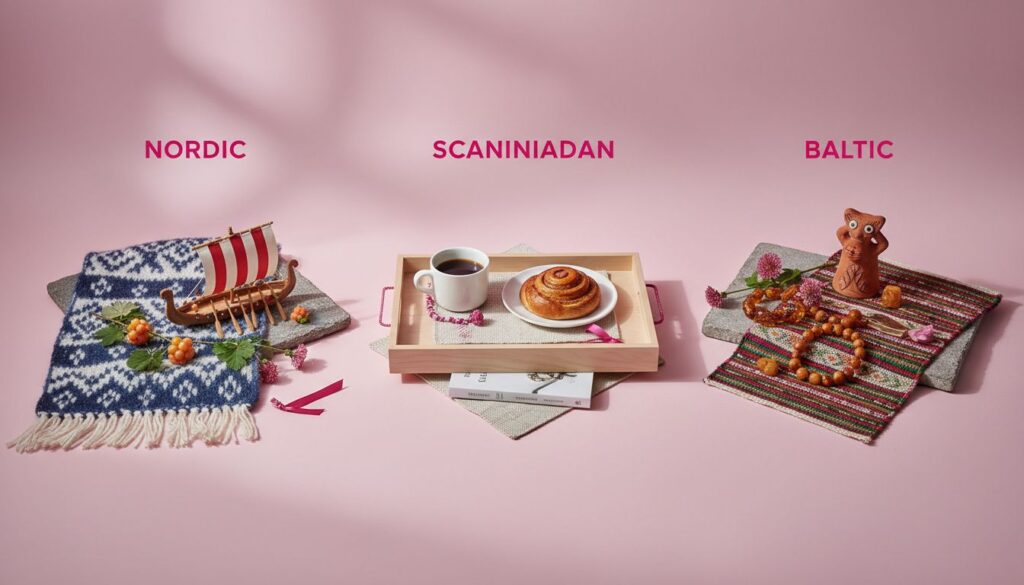
You do not need a geography degree to sort out nordic vs scandinavian vs baltic. The short version is simple: Scandinavia is the narrowest label, Nordic is the broader regional one, and Baltic is a separate grouping for Estonia, Latvia, and Lithuania. (britannica.com)
That difference matters because the words are often used as if they were interchangeable, especially in travel writing and casual conversation. In practice, they point to different mixes of geography, language, and history, so using the right one makes your writing clearer and more accurate. (britannica.com)
Nordic vs Scandinavian vs Baltic at a glance

The standard definitions below follow Britannica's usage and the Nordic Council's official grouping. (britannica.com)
| Term | Usual countries | Core idea |
|---|---|---|
| Scandinavia | Denmark, Norway, Sweden | Narrow geographic and cultural term |
| Nordic | Denmark, Norway, Sweden, Finland, Iceland, plus Faroe Islands, Greenland, and Åland in official co-operation | Broader regional umbrella |
| Baltic | Estonia, Latvia, Lithuania | Separate eastern Baltic Sea region |
Some authors use Scandinavia more loosely, but the three-country version is the safest default for general readers. (britannica.com)
What Scandinavia means
Scandinavia is the narrowest of the three labels. Britannica generally defines it as Denmark, Norway, and Sweden, with Norway and Sweden occupying the Scandinavian Peninsula and Denmark included because of historical and cultural ties. Some writers stretch the word to include Finland, Iceland, or the Faroe Islands, but that broader use is not the one most readers expect. (britannica.com)
If you want the cleanest everyday meaning, think of Scandinavia as the classic three-country trio. That is the version most people picture when they hear the term, and it is the version that works best in plain English, whether you are writing about culture, geography, or regional destinations across Scandinavia and the Nordics. (britannica.com)
What Nordic means
Nordic is broader and more modern as a regional term. The Nordic Council says official Nordic co-operation involves Denmark, Finland, Iceland, Norway, Sweden, the Faroe Islands, Greenland, and Åland. Britannica likewise describes the Nordic countries as the wider grouping that appears when the Scandinavian core is expanded. In other words, every Scandinavian country is Nordic, but not every Nordic country is Scandinavian. (norden.org)
That wider label is why Nordic is the safest choice when you are talking about shared institutions, policy, or culture across the full region. It is also the term that best matches a broader reading list, so if you are looking for ideas beyond a single country, Nordic travel inspiration fits the concept better than a strictly Scandinavian filter. (norden.org)
What Baltic means
Baltic refers to Estonia, Latvia, and Lithuania. Britannica describes the Baltic states as the countries on the eastern shore of the Baltic Sea, and that sea is what gives the region its name. This is a separate grouping from Scandinavia and from the Nordic countries, even though the regions are all part of Northern Europe. (britannica.com)
Britannica also notes that the name has sometimes been used more loosely in older or broader contexts, but modern standard usage usually means those three countries and nothing else. If you want to keep your terminology crisp, that is the version to use. (britannica.com)
Why the terms get mixed up on a map
The confusion usually starts with geography. Scandinavia sits around the Scandinavian Peninsula and nearby waters, while the Nordic region spreads farther across the North Atlantic and includes Finland and the autonomous territories of the Faroe Islands, Greenland, and Åland. The Baltic states sit to the east, facing the Baltic Sea. Once you draw those three zones, the terminology becomes much easier to remember. (britannica.com)
This is why a map-based explanation works so well. The countries are close, the coastlines are connected, and the seas between them encourage trade and travel, but proximity does not make the labels identical. If you are planning a trip, it helps to think in routes and regions rather than just country names.
Language and culture are part of the story

Language is one of the best clues. The Scandinavian languages are part of the North Germanic family, and Britannica also groups Icelandic and Faroese with them in a broader Scandinavian-language family. The Nordic Council, meanwhile, treats Danish, Finnish, Icelandic, Norwegian, and Swedish as the official languages used in Nordic co-operation. In the Baltic states, Finnish and Estonian belong to the Uralic family, while Lithuanian is a Baltic language and one of the most archaic surviving Indo-European languages. (britannica.com)
That language split helps explain why the region feels connected in some places and distinct in others. Danish, Norwegian, and Swedish share close historical ties. Finland has deep links to both the Nordic world and the Uralic language family. Estonia, Latvia, and Lithuania, while located near the Nordic countries, developed their own linguistic identities over time. (norden.org)
If you like understanding places through culture as much as geography, the about Scandinavia Holiday page gives a sense of the travel perspective behind this kind of regional storytelling.
History adds another layer
The Nordic and Scandinavian labels also carry a lot of history. Britannica links Scandinavia to long-running cultural and linguistic continuity, including the Viking Age, when North Germanic speech spread across a wide area. That is part of why the term still feels culturally loaded, not just geographic. (britannica.com)
The Baltic states followed a different historical path. Britannica describes their modern national histories in terms of independent statehood, Soviet occupation in 1940, and restored independence in 1991. That separate trajectory is one reason Baltic identity is discussed on its own, even when the countries are grouped beside the Nordic region in wider Northern European conversations. (britannica.com)
How to use the terms correctly
If you need a clean rule of thumb, use the term that matches the scale of what you mean.
- Use Scandinavia when you mean Denmark, Norway, and Sweden. (britannica.com)
- Use Nordic when you mean the broader official region, including Finland, Iceland, and the related territories in Nordic co-operation. (norden.org)
- Use Baltic when you mean Estonia, Latvia, and Lithuania. (britannica.com)
That small choice prevents a lot of confusion in headlines, travel guides, and SEO copy, especially when readers may not know whether you mean a peninsula, a political cooperation group, or a Baltic Sea coastline.
Common questions about nordic vs scandinavian vs baltic

Is Finland Scandinavian?
Usually no. Finland is Nordic, but standard definitions of Scandinavia usually limit the term to Denmark, Norway, and Sweden. Some broader uses exist, but they are not the default. (britannica.com)
Is Iceland Scandinavian?
Usually no in the everyday sense. Iceland is part of the Nordic countries and is included in official Nordic co-operation, but it is not usually part of the narrow Scandinavia definition. (britannica.com)
Are the Baltic states Nordic?
No, not in standard modern usage. The Baltic states are Estonia, Latvia, and Lithuania, and they are treated as their own regional grouping. (britannica.com)
Is Denmark Nordic or Scandinavian?
Both. Denmark belongs to Scandinavia in the usual sense, and it is also part of the wider Nordic region and its official cooperation framework. (britannica.com)
Why do people mix these terms up?
Because geography, language, and history overlap. The countries are close together, several of their languages are related, and the region has centuries of shared political and cultural contact. (britannica.com)
Is the Baltic Sea the same as the Baltic states?
No. The Baltic Sea is a body of water. The Baltic states are Estonia, Latvia, and Lithuania, named because they sit on the sea's eastern shore. (britannica.com)
The simplest way to remember the difference
Scandinavia is the core trio, Nordic is the broader official family, and Baltic is the separate eastern Baltic Sea grouping. When you use those labels carefully, your writing becomes more precise and your readers do not have to guess what map you mean. (britannica.com)
If you are writing for travelers, that distinction is especially useful. It helps you describe a route, a culture, or a coastline without accidentally mixing three different regional ideas into one.
Article created using Lovarank